Stampede
Distressor energy, narrowed to drums. Plus Bloom, the harmonic sustain that the original doesn't have.
Tempo-locked attack and release — the compressor sits inside the groove.
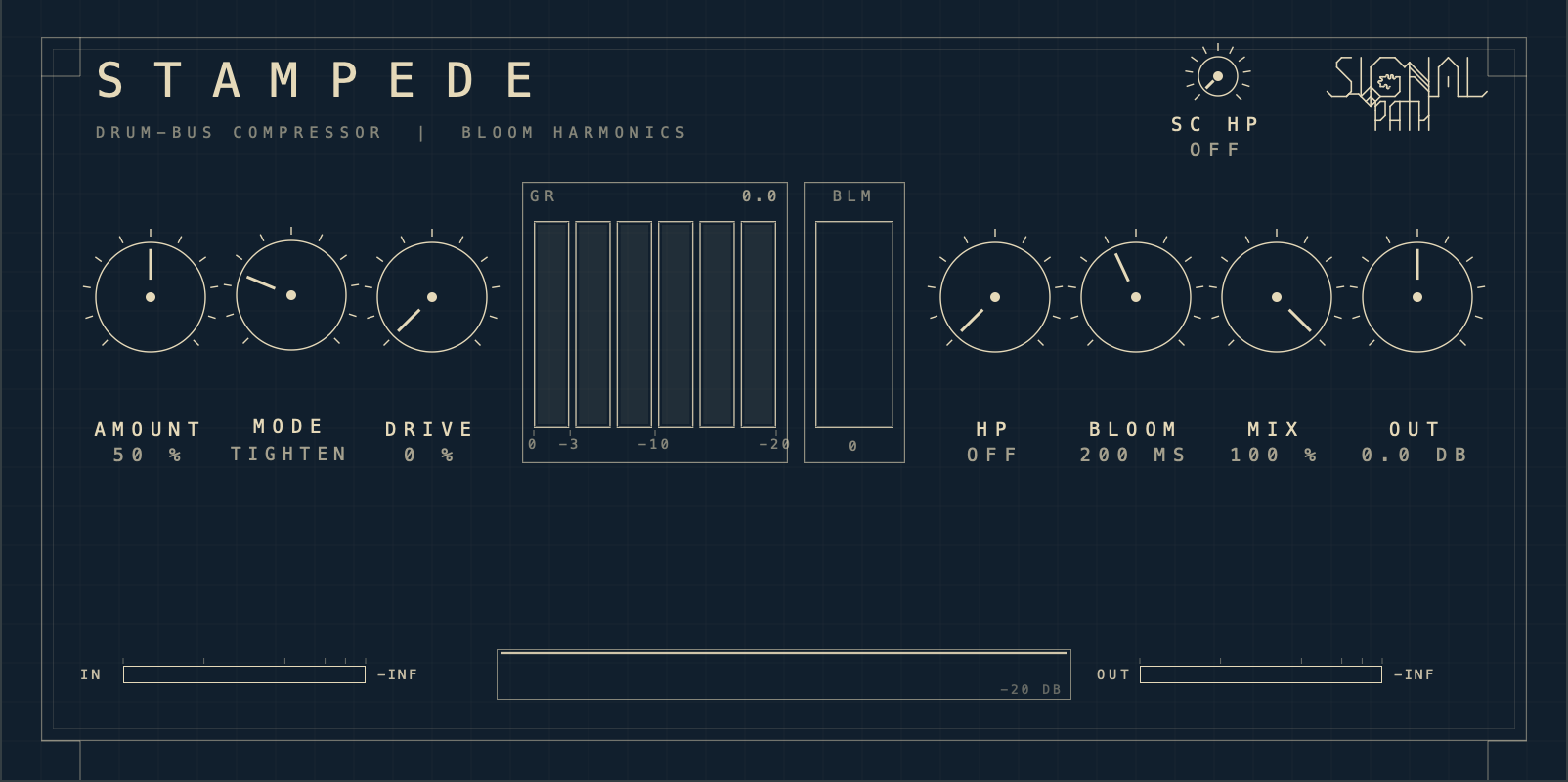
Distressor energy, narrowed to drums. Plus Bloom, the harmonic sustain that the original doesn't have.
Tempo-locked attack and release — the compressor sits inside the groove.
Not a ratio number. Five programs — GLUE, TIGHTEN, SMASH, NUKE, TEAR — each a curated bundle of attack, release, knee, and saturation. Named for the job, not the math. You pick the sound you want; the ballistics come with it.
A fast envelope drives the gain stage. A slow envelope, set by the Bloom knob, follows it downward only and drives the harmonic generator. The compressor releases. The grit keeps ringing. Pick attack stays tight. The note tail tears open.
External stereo sidechain input. Sidechain HP from 20 Hz to 500 Hz, plus Off. Link / unlink toggle for the L+R detector. Trigger source displayed as a mini-meter so you can see what the comp is hearing, not guess.
ATTACK and RELEASE are first-class knobs with a TIME / SYNC toggle on each. TIME sweeps a continuous range; SYNC snaps to musical note values — dotted, triplet, straight — and computes the time in seconds from the host's transport tempo at every sample.
For a drum bus, that's the difference between being on the grid and driving against it. A release tuned to 1/16T pumps with the hat. An attack at 1/256 lets every transient through, no matter the BPM. Pump in time — not by happy accident.
When the host isn't reporting a valid tempo (e.g. standalone with no clock), SYNC falls back to its current TIME-equivalent silently. No clicks, no surprises.
Each mode is a curated bundle of ratio, knee, and saturation profile. ATTACK and RELEASE defaults come with the mode but are independently user-controllable — see the per-mode defaults below.
| Mode | Ratio (eff.) | Knee | Saturation | Best for |
|---|---|---|---|---|
| GLUE | ~3:1 | 12 dB | Subtle 2nd harm. | Cohesive bus, transparent. |
| TIGHTEN | ~6:1 | 6 dB | Moderate 2nd / 3rd. | Snappier punch. |
| SMASH | ~12:1 | 3 dB | Heavy 3rd. | NY parallel, room mics. |
| NUKE | ∞:1 (soft) | 1 dB | Soft-clip limiter. | Destroy it. |
| TEAR | ∞:1 + feedback | 1 dB | 5th/7th + detector feedback. | Mick Gordon territory. |
| Mode | Attack · TIME | Attack · SYNC | Release · TIME | Release · SYNC |
|---|---|---|---|---|
| GLUE | 30 ms | 1/64 | 250 ms | 1/8 |
| TIGHTEN | 5 ms | 1/128 | 120 ms | 1/16 |
| SMASH | 1 ms | 1/256 | 80 ms | 1/16T |
| NUKE | 0.3 ms | 1/256 | 60 ms | 1/32 |
| TEAR | 0.3 ms | 1/256 | 300 ms | 1/8T |
Decouple gain release from harmonic decay. That's the whole idea.
In a real Distressor the compression release and the distortion fade together — they're coupled to the same gain stage. Stampede splits them.
One fast envelope tracks the instantaneous gain reduction and drives the compressor. A second envelope — set by the Bloom knob from 50 ms to 2 s — follows the fast one downward only, never attacking, and drives the harmonic generator independently.
Pick attack still hits tight. The note tail tears open as the distortion sustains. At max Bloom, harmonics keep ringing well after the gain has fully recovered. Bloom scales with the GR magnitude so it stays tied to the signal — not a pad on top.
In GLUE, Bloom is nearly inaudible — there's no saturation to sustain. In TEAR, Bloom is the effect.
Audio examples land here. Drum bus before / after, parallel comp on room mics, TEAR mode on a guitar.
Same loop, mode swept. Listen for the bloom growing in with the ratio.
Room mics, smashed and blended back. The tail keeps ringing after the comp has let go.
Off-label use. The detector feedback adds the 5th/7th harmonic sneer at the top of the chord.
Drop your email and we'll write you when the beta opens. No list, no newsletter — one email when there's something to hear.
Pricing TBD. VST3 + AU. macOS Universal first; Windows follows.