Doubler
Two voices generated from the mono input. Each side gets its own micro-detune (±15 ¢) and its own delay variation (5–25 ms), modulated by a slow random LFO. Subtle gain wobble on top. The result reads as two real human takes, not a chorus.
Two guitars, one input. Compressed phantom-centre reverb that can't muddy the dry.
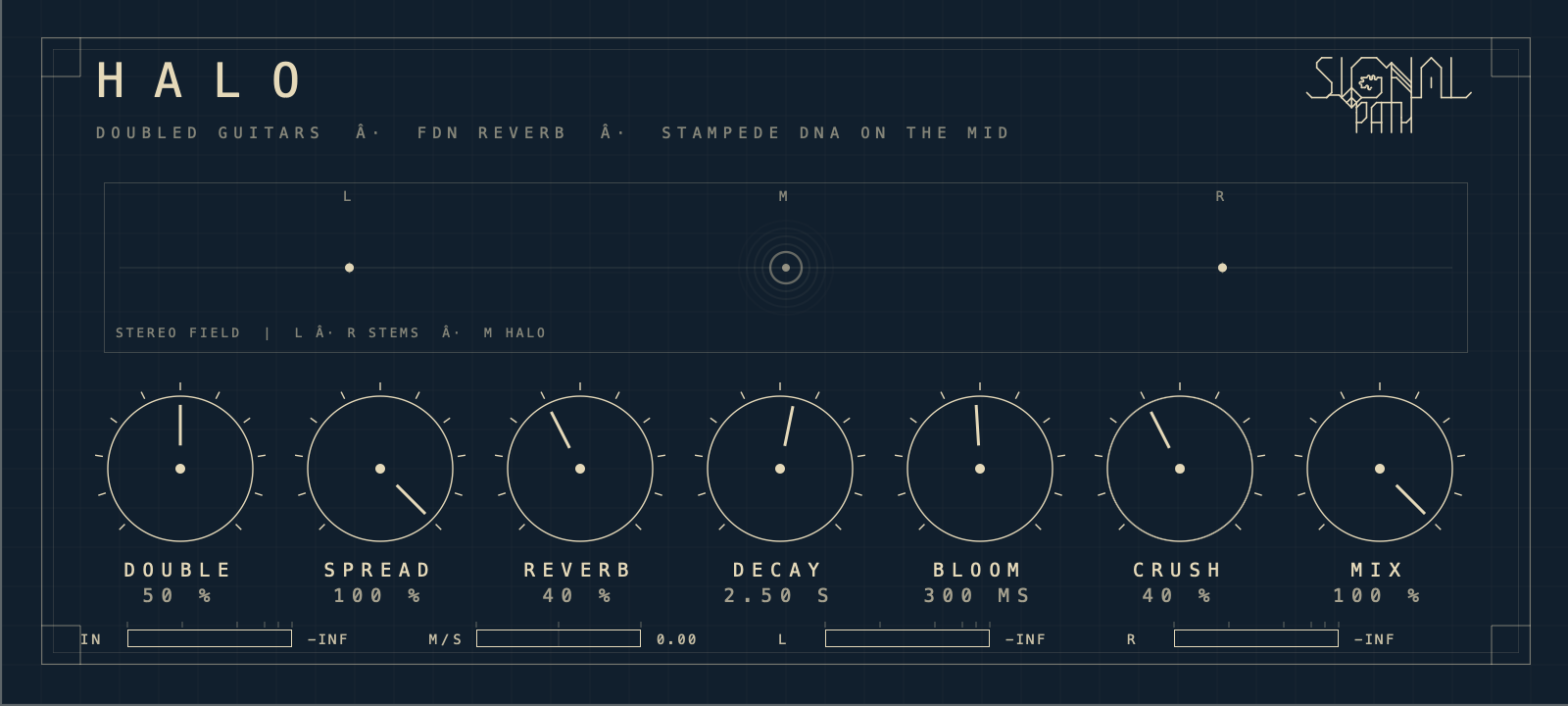
Two voices generated from the mono input. Each side gets its own micro-detune (±15 ¢) and its own delay variation (5–25 ms), modulated by a slow random LFO. Subtle gain wobble on top. The result reads as two real human takes, not a chorus.
Hard-pan the voices, then split the resulting stereo into M and S. Process M only. Recombine. The dry guitars stay in their L and R panning slots untouched. The reverb tail grows in the centre, where there's no dry content to compete with — clean stereo image, breathing phantom centre.
An 8-line Hadamard FDN — Fray's reverb architecture, extended — handles the tail. Then a Stampede-derived soft-knee comp, Bloom envelope, and harmonic generator give it weight. The side channel never sees any of this. Reverb that sustains and saturates without smearing the picks.
Producers do this by hand all the time. Record a guitar twice. Hard-pan take 1 left, take 2 right. Send both to a reverb bus. Process that bus with a compressor and some saturation for character. Print.
What makes it work is that the reverb tail naturally sits in the phantom centre of the stereo signal — it's the shared content between L and R. Compress and saturate that shared content separately and the dry guitars on the sides stay clear.
Halo collapses that twenty-minute routing setup into a single mono-in / stereo-out plugin and makes it work in real time on a live input.
MONO INPUT
   │
   ▼
[Doubler]  ── micro-detune (±5–15 ¢) + variable delay (5–25 ms) per side
   │ │
   L R    ── hard-panned by SPREAD
   │ │
   ▼ ▼
[M/S Split]   M = (L+R)/2,  S = (L−R)/2
   │     │
   M     S    ← side bypasses everything
   │     │
   ▼     │
[8-line Hadamard FDN reverb]   ← from Fray, extended
   │     │
   ▼     │
[Compressor + Bloom + Harmonic generator]   ← from Stampede
   │     │
   ▼     ▼
[M/S Recombine]   L' = M' + S,  R' = M' − S
   │ │
STEREO OUTPUT
The side channel — the doubled guitar pair — is never processed. It passes through dry. All character lives on M.
Two for the doubler, four for the mid-channel chain, one for mix. The whole technique on one panel.
Each Signal Path plugin does one job. The four lock together into a chain — but Halo, like its siblings, stands alone.
Shapes tone. Filter and saturation.
02Destroys dynamics. Comp and Bloom.
Packages the mid-reverb workflow.
Unravels texture. Grains and FDN.
Audio examples land with the public release. One mono guitar into Halo, recorded as a stereo print.
Implementation lands after Stampede and Fray stabilise — Halo borrows DSP from both. Drop an email and we'll write when the first build is signed and notarised.